
- September 8, 2026
- neeraj upreti
- 0
Balance Transfer vs Loan Top-Up: 7 Key Differences You Should Know
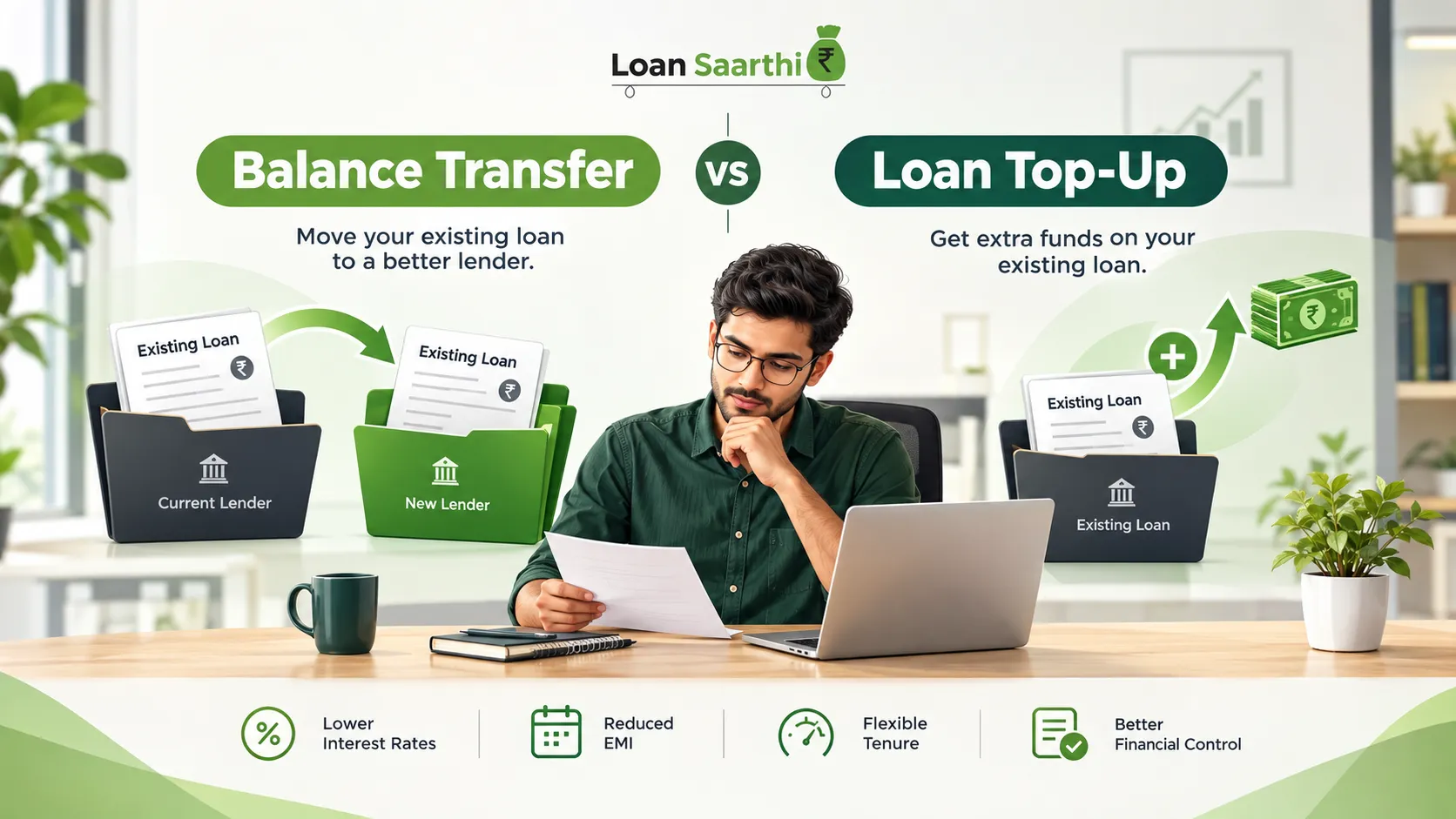
Balance transfer vs loan top-up is an important comparison for borrowers who already have an active loan but need better repayment terms or additional funds. While both options can help manage your borrowing, they serve different purposes. A balance transfer generally involves moving an existing loan from one lender to another, often to get more suitable interest rates or repayment terms. A top-up loan, on the other hand, allows an existing borrower to obtain additional funds over and above an existing loan, subject to the lender’s eligibility criteria.
Choosing between the two should not be based only on the interest rate or the amount you can borrow. Processing fees, foreclosure or prepayment costs, remaining tenure, outstanding principal, repayment capacity and the total cost of borrowing can all affect which option makes more financial sense.
In this guide, Loan Saarthi explains the difference between a balance transfer and a top-up loan in simple terms, along with examples, advantages, limitations and practical factors you should consider before making a decision.
Table of Contents
- What Is a Loan Balance Transfer?
- What Is a Top-Up Loan?
- Balance Transfer vs Loan Top-Up: Key Differences
- Detailed Comparison Table
- Real-Life Example
- Benefits of a Balance Transfer
- Benefits of a Top-Up Loan
- Charges and Costs You Should Check
- How to Choose Between the Two
- Common Mistakes to Avoid
- Practical Tips Before Applying
- Final Verdict
- Frequently Asked Questions
What Is a Loan Balance Transfer?
A loan balance transfer means transferring your outstanding loan from your existing lender to another lender. Borrowers generally consider this option when another lender offers terms that may be more suitable, such as a potentially lower interest rate, a different repayment structure or other features.
For example, suppose you have an outstanding home loan balance of ₹20 lakh with several years remaining on the repayment period. If another lender offers a more competitive rate and the overall savings after considering all transfer-related costs are meaningful, you may consider moving the outstanding loan.
However, a lower advertised interest rate does not automatically mean that a balance transfer will save money. You should compare the total cost of the existing loan with the total cost of the new loan, including applicable processing fees, documentation charges, legal or valuation costs where relevant, and any applicable prepayment or foreclosure charges.
Before making a decision, borrowers can use the Loan Saarthi EMI Calculator to compare potential EMI and repayment scenarios.
When Can a Balance Transfer Make Sense?
A balance transfer may be worth evaluating when:
- Your current loan interest rate is significantly higher than an alternative offer.
- You have a substantial outstanding principal balance.
- You still have a meaningful portion of the loan tenure remaining.
- The potential interest savings are higher than the transfer-related costs.
- You want to explore different repayment terms or lender features.
It is important to remember that the new lender will generally assess your income, credit profile, existing obligations, repayment history and other eligibility factors before approving a transfer.
What Is a Top-Up Loan?
A top-up loan is additional borrowing offered to an existing borrower who meets the lender’s eligibility requirements. It is usually linked to an existing loan relationship. Depending on the product and lender, a top-up may be available on certain home loans or other eligible loan products.
Imagine you already have a home loan and need ₹5 lakh for home renovation, education, medical expenses or another legitimate financial requirement. If your lender offers a top-up facility and you qualify, you may be able to borrow an additional amount without taking an entirely separate loan from a different lender.
The exact amount available, interest rate, tenure and permitted use of funds vary by lender and loan type. Some lenders may also require a minimum repayment history before considering a top-up.
Loan Saarthi’s home loan solutions include facilities such as balance transfers and top-ups, subject to applicable lender terms and eligibility.
When Can a Top-Up Loan Make Sense?
A top-up may be worth considering when:
- You already have an eligible loan with a lender.
- You have a genuine need for additional funds.
- Your repayment record is satisfactory.
- The lender offers a suitable top-up rate and repayment period.
- The total additional borrowing fits comfortably within your repayment capacity.
Balance Transfer vs Loan Top-Up: Key Differences
The biggest difference in balance transfer vs loan top-up is the primary purpose. A balance transfer focuses on an existing loan, while a top-up provides additional borrowing on top of an existing eligible loan.
1. Primary Purpose
A balance transfer is mainly considered to move an existing outstanding loan to another lender under potentially more suitable terms.
A top-up is primarily used when an existing borrower needs additional funds while continuing with an eligible existing loan arrangement.
2. Existing Loan Is Important in Both Cases
Both options generally require an existing loan relationship. However, the way that existing loan is used differs.
With a balance transfer, the outstanding loan is transferred to a new lender. With a top-up, the existing loan continues and an additional amount may be sanctioned, subject to eligibility.
3. Interest Rate
The interest rate can vary depending on the lender, borrower profile, loan type, credit history, income, outstanding amount and other factors.
A borrower considering a balance transfer should compare the existing rate with the proposed new rate. A borrower considering a top-up should compare the top-up rate with other available borrowing alternatives.
4. Additional Funds
A balance transfer by itself is primarily about shifting the outstanding loan. Some lenders may offer a combination of balance transfer and additional funding, but this depends on the loan product and lender.
A top-up specifically addresses the requirement for additional funds, provided the borrower qualifies for the additional amount.
5. Processing and Other Charges
Both options can involve charges. These may include processing fees and other applicable costs depending on the lender and product.
For a balance transfer, you should also investigate any applicable charges associated with closing or transferring the existing loan. For a top-up, check the processing fee, documentation requirements and any other applicable charges before accepting the offer.
6. Eligibility
Eligibility is not identical across lenders. A balance transfer may involve an assessment of your existing repayment record and current financial profile. A top-up may also depend on your existing loan repayment history, outstanding balance, income and the lender’s internal policies.
7. Best Use Case
A balance transfer can be more relevant when the main concern is the cost or terms of an existing loan. A top-up can be more relevant when the main requirement is additional funds and the existing loan arrangement remains suitable.
Detailed Comparison Table
| Factor | Balance Transfer | Top-Up Loan |
|---|---|---|
| Primary purpose | Move an existing loan to another lender | Borrow additional funds on an eligible existing loan |
| Existing loan | Outstanding loan is transferred | Existing loan generally continues |
| Additional funds | Not the primary purpose | Yes, subject to eligibility |
| Interest rate | New lender’s applicable rate | Rate offered for the top-up facility |
| Eligibility | Depends on new lender’s assessment | Depends on existing lender/product and borrower eligibility |
| Key objective | Potentially improve loan terms or cost | Meet an additional funding requirement |
| Charges | May include transfer, processing and applicable closure-related costs | May include processing and other applicable charges |
| Best suited for | Borrowers evaluating better terms for an existing loan | Borrowers who need additional funds and qualify for a top-up |
Real-Life Example: Which Option Could Be More Relevant?
Consider a borrower who has an outstanding home loan of ₹15 lakh and still has several years remaining on the loan.
Scenario A: The borrower wants to reduce the cost of the existing loan
Suppose the borrower’s current loan carries a higher applicable interest rate than an alternative offer. The borrower could investigate a balance transfer. However, the borrower should first calculate the potential interest difference and subtract all applicable transfer-related costs.
If the estimated saving is ₹1.50 lakh but the total transfer-related costs are ₹60,000, the potential net benefit would be approximately ₹90,000, before considering other factors. The actual benefit will depend on the lender’s terms, remaining tenure, outstanding balance and repayment structure.
Scenario B: The borrower needs additional funds
Now suppose the same borrower needs ₹3 lakh for a planned home renovation and the existing lender offers a suitable top-up facility. In that case, a top-up may be worth evaluating because it directly addresses the additional funding requirement.
These examples demonstrate why there is no universal answer to the question of which option is better. The right choice depends on why you need the facility and what the complete cost looks like.
Benefits of a Balance Transfer
A balance transfer may offer several potential advantages when the numbers work in your favour.
- Potential interest savings: A lower applicable interest rate may reduce the overall interest payable, especially when a substantial principal remains.
- Opportunity to review loan terms: Transferring your loan gives you an opportunity to compare repayment structures and lender policies.
- Potentially better repayment planning: A different tenure or EMI structure may suit your current financial situation better.
- Competitive lender offers: Comparing lenders can help you understand whether your current loan terms remain competitive.
However, these are potential benefits, not guaranteed savings. Always compare the complete cost rather than focusing only on the advertised interest rate.
Benefits of a Top-Up Loan
A top-up loan can be useful for an existing borrower who needs additional funds without wanting to completely restructure the underlying loan.
- Additional borrowing: It can provide extra funds subject to eligibility.
- Convenience: Existing borrowers may find the process more straightforward than applying for an unrelated new loan, depending on the lender.
- Single repayment planning: Depending on the product structure, the additional borrowing may be managed alongside the existing loan.
- Useful for specific financial requirements: Depending on lender terms, top-up funds may be used for purposes such as renovation or other permitted expenses.
Do not assume that a top-up is automatically cheaper than every other borrowing option. Compare the interest rate, tenure, processing charges and total repayment before accepting the offer.
Charges and Costs You Should Check
One of the most important parts of balance transfer vs loan top-up is understanding the complete cost of borrowing.
Depending on the loan and lender, check the following:
- Interest rate and applicable benchmark or pricing structure
- Processing fee
- Documentation or administrative charges
- Applicable foreclosure or prepayment charges
- Any legal or valuation costs, where applicable
- Late payment or penal charges
- Insurance or other optional charges, if offered
- Charges associated with switching or changing certain loan terms
The Reserve Bank of India has issued guidelines requiring relevant lenders to provide transparency around important loan terms and charges. The RBI’s Key Facts Statement framework also focuses on presenting key loan information, including interest and applicable fees, in a standardised manner. Borrowers should carefully read the lender’s current Key Facts Statement and sanction documents before accepting a loan. Reserve Bank of India (RBI)
RBI guidance also addresses how certain floating-rate loans and prepayment charges are handled. The exact applicability depends on the loan type, lender category, borrower and purpose, so do not assume that one rule applies to every loan. RBI guidance on floating-rate EMI-based personal loans
How to Choose Between Balance Transfer and Top-Up
The best option depends on your financial objective. Ask yourself these questions before making a decision.
1. Why do I need the facility?
If you mainly want to review or potentially reduce the cost of your existing loan, investigate a balance transfer. If you need additional money while your existing loan remains suitable, investigate a top-up.
2. How much do I still owe?
A balance transfer may have greater potential impact when the outstanding principal is substantial and there is significant tenure remaining. If only a small amount remains, transfer-related costs may reduce the potential benefit.
3. What is the total cost?
Do not compare only two interest rates. Compare the total amount payable, processing charges and other applicable costs.
4. Can I comfortably afford the new EMI?
Additional borrowing increases your overall debt burden. Use the Loan Saarthi EMI Calculator to estimate how a different loan amount, interest rate or tenure could affect your monthly repayment.
5. Have I checked the lender’s current terms?
Loan rates, fees, eligibility criteria and policies can change. Always verify the current offer directly from the lender before making a financial commitment.
Common Mistakes to Avoid
- Choosing only by interest rate: A lower rate may not result in savings if other costs are high.
- Ignoring the remaining tenure: A transfer may be less useful when the existing loan is close to completion.
- Borrowing more than necessary: A top-up should be based on a genuine financial requirement and repayment capacity.
- Not checking prepayment terms: Understand applicable charges before closing or transferring an existing loan.
- Extending the tenure without calculating total interest: A lower EMI can sometimes come with a longer repayment period and higher total interest.
- Ignoring documentation: Read the sanction letter, Key Facts Statement and other loan documents carefully.
- Taking multiple loans without assessing repayment capacity: Additional debt can put pressure on your monthly budget.
Practical Tips Before Applying
- Write down your current outstanding principal and remaining tenure.
- Check your current interest rate and EMI.
- Ask the lender for a detailed outstanding loan statement.
- Compare at least the complete cost of the alternative offer, not just the headline rate.
- Ask for all applicable fees and charges in writing.
- Check whether the new EMI fits comfortably into your monthly budget.
- Do not extend the tenure simply to make the EMI look smaller without checking total interest payable.
- Read the lender’s Key Facts Statement and sanction letter before accepting the offer.
- Keep your repayment history clean and avoid taking unnecessary debt.
RBI guidance emphasises transparency around loan terms, charges and important conditions. Borrowers should therefore ask the lender to clearly explain costs that may affect the overall borrowing expense. RBI Fair Practices Code guidance
Final Verdict: Balance Transfer or Top-Up?
There is no single answer to the question of balance transfer vs loan top-up. The better option depends on your financial goal.
If your primary objective is to potentially improve the terms or cost of an existing loan, a balance transfer may be worth evaluating. If you already have a suitable loan and need additional funds, a top-up may be more relevant, provided you qualify and can comfortably manage the additional repayment.
Before choosing either option, compare the interest rate, outstanding principal, remaining tenure, EMI, processing fees, applicable prepayment or foreclosure charges and total repayment amount. Most importantly, do not take additional borrowing simply because it is available. Borrow only what you genuinely need and what your repayment capacity can support.
For more information about loan options and financial guidance, visit the Loan Saarthi website.
Frequently Asked Questions
1. What is the difference between a balance transfer and a top-up loan?
A balance transfer generally means moving an existing outstanding loan from one lender to another. A top-up loan provides additional funds to an existing eligible borrower while the underlying loan generally continues. The exact structure depends on the lender and loan product.
2. Is a balance transfer always cheaper than a top-up loan?
No. The cost depends on the interest rate, outstanding amount, tenure, processing charges and other applicable costs. A balance transfer may be useful when the overall savings justify the transfer costs, while a top-up is primarily intended to meet an additional funding requirement.
3. Can I get a top-up loan after taking a home loan?
Some lenders offer top-up facilities to eligible home loan borrowers. Eligibility, minimum repayment history, additional amount, interest rate and permitted use of funds can vary by lender.
4. Does a balance transfer reduce my EMI?
It can potentially reduce the EMI if the new loan has a lower applicable interest rate or a different tenure, but this is not guaranteed. A longer tenure may reduce the monthly EMI while increasing the total interest payable.
5. What charges should I check before a loan balance transfer?
Check processing fees, applicable prepayment or foreclosure charges, documentation charges, legal or valuation costs where relevant, and any other fees listed by the existing and new lender. Compare these costs with the potential interest savings.
6. Is a top-up loan considered a new loan?
A top-up is additional borrowing linked to an existing eligible loan, but the exact structure, documentation and account treatment can vary by lender and product. Always check the lender’s offer documents before accepting it.
7. Can I transfer my loan and take a top-up at the same time?
Some lenders may offer a balance transfer along with additional funding, subject to their product structure and eligibility criteria. You should compare the combined cost and repayment obligation before proceeding.
8. Does a balance transfer affect my credit profile?
A loan transfer involves a new lender and may involve credit assessment and related enquiries. The effect on your credit profile depends on your individual circumstances and how the transfer is reported. Maintaining timely repayments remains important.
9. Should I choose a lower EMI or a shorter loan tenure?
A shorter tenure can generally help you repay the loan sooner and may reduce total interest, while a longer tenure can make the monthly EMI more manageable but may increase the overall interest cost. The suitable choice depends on your repayment capacity and financial priorities.
10. What should I check before accepting a top-up loan?
Check the additional amount, interest rate, tenure, EMI, processing fee, total repayment, applicable charges, permitted use of funds and how the top-up affects your overall debt obligation. Make sure the additional EMI fits comfortably within your budget.
Disclaimer: This article is intended for general financial education and should not be treated as personalised financial advice. Interest rates, fees, eligibility requirements, repayment terms and lender policies can vary and may change over time. Always verify the latest terms and conditions with the relevant lender before making a borrowing decision.